Why 70% of Change Initiatives Fail in 2026 (And How Behavioral Nudges Fix the Human Side Fast)
In my 35 years leading change, I have watched the same story play out dozens of times. A company invests millions in a transformation. The strategy is sound. The technology is solid. The frameworks are in place. And still, six months later, people are quietly doing things the old way.
I have seen this happen at global manufacturers, financial services firms, and Fortune 500 tech companies. I have seen it in markets across Asia, Europe, and the Americas. And in almost every case, the failure had nothing to do with the plan.
It had everything to do with the people running the plan.
The layer most companies miss
At Amway, I built the enterprise change practice from scratch. My team consulted on 50 strategic initiatives across 100 global markets. Read more here. We used PROSCI and our own frameworks to create structure and process. They worked. But before we added what I now call the behavioral stack on top of them, the majority of our initiatives still fell short of their goals. Project needed rework. We lost valuable time. Teams that followed instructions under pressure quietly reverted the moment attention moved elsewhere.
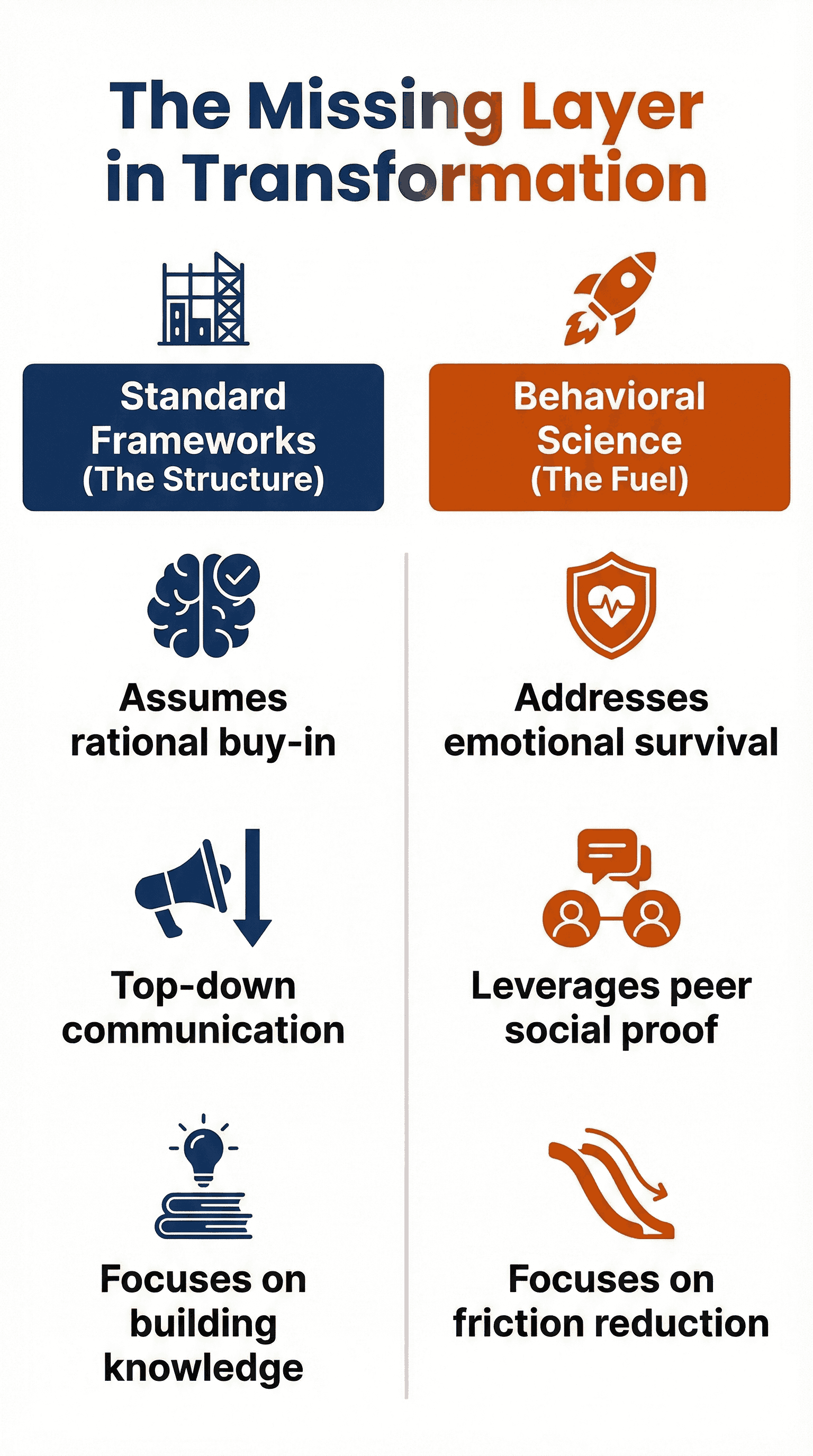
PROSCI and frameworks like it give you the roadmap. Behavioral science gives you the fuel to actually travel it.
The difference matters more now than it ever has. Hybrid work has made it harder to build the face-to-face trust that change depends on. Years of layoffs have bred real cynicism. Employees are dealing with change fatigue — they have been through too many rollouts, too many reorganizations, too many “this time it will be different” announcements. And now AI is adding a new layer of anxiety about job security that most change plans are not addressing at all.
I see employees tuning out. Quietly quitting without leaving. Gen Z and Gen Alpha, in particular, are not interested in top-down direction. They want purpose and psychological safety, and if your change initiative does not offer either, they will disengage politely and completely.
Where the frameworks stop short
PROSCI’s ADKAR model is genuinely excellent. It forces the right questions. Do people know why the change matters? Do they have the skills to execute it? In my experience, most companies focus heavily here — on communication and training — and believe that is enough.
It is not.
In practice, initiatives consistently stall at the Desire stage or collapse after go-live. ADKAR assumes that if people understand the change and have the skills to execute it, buy-in will follow. What it does not fully account for are the cognitive biases, emotional triggers, and deeply wired survival instincts that turn logical corporate plans into quiet human resistance.
In my COE work, I saw perfect change plans on paper that meant nothing in practice. I saw fear of job loss. Fear of losing status. Deep discomfort about new daily routines. Most of it was invisible — people would follow instructions under pressure, perform compliance when someone was watching, and then revert the moment the project closed.
Resistance is not defiance. It is a survival mechanism. Frameworks give you structure. Behavioral science gives you the tools to lower the emotional temperature and make adoption feel natural rather than forced.
I never replaced the frameworks like PROSCI. They are needed to lay out the process of Organizational Change Management. I used them as the backbone. But the difference between good execution and genuine, lasting adoption came from adding behavioral techniques early — techniques rooted in decades of rigorous psychology research, not intuition or guesswork.
Here are three of them, with real cases behind each one.
When a merger turned into a rebellion – Case Study 1
I consulted on a post-merger integration for a global software manufacturer that was quietly falling apart. The operations teams had been handed new centralized reporting tools and wanted nothing to do with them. The project leaders were ready to mandate more training — more sessions, more slides, more explaining. I had to stop them.
The problem was not knowledge. People understood the software fine. The problem was that nobody had asked them anything. And remember they were from a different entity prior to the merger with a different culture. The tool had landed on their desks like a memo from another planet, and they were pushing back the only way they could — by ignoring it.
So we paused the rollout and ran co-creation clinics instead. We told the frontline managers: here is the outcome we cannot change. How would you design the workflow to actually get there? We then implemented exactly what they designed, without second-guessing the details.
The resistance disappeared almost immediately. Because it was their process now. We cut implementation time in half. Post go-live complaints dropped dramatically.
The Science: There is a well-documented psychological principle behind this called the IKEA Effect. People disproportionately value and defend things they helped build. PROSCI tells you to build desire. Co-creation is how you actually do it. It transforms employees from passive recipients of a top-down mandate into active architects of their own workflows.
Try this: Instead of saying “here is the new workflow starting Monday,” say “here is the outcome we need by Monday — how would your team design the steps to get there?” Watch what happens to the energy in the room.
When compliance emails made things worse – Case Study 2
A manufacturing firm was struggling to get its engineering teams onto mandatory time-tracking software. The standard approach — firmwide emails from top executives and from HR emphasizing compliance — was actively making things worse. The more they pushed, the more cynical people became. The change team wanted to escalate to HR warnings.
I asked them to try something different first.
We identified three early adopter teams who were already using the tool comfortably. We started quietly surfacing their adoption numbers in weekly updates — not as a threat, but as a simple observation. Most of your backend engineering peers are already doing this. Here is what they are saying about it. We published the data related to their success, their pictures, interviews with them in the internal newsletter on the company’s online communication portal, organized “Lunch and Learns” in departments to have these adopters share their stories..
That was enough. Within three weeks, compliance hit 92 percent. No punitive action. No additional training. Just the quiet social signal that respected peers had already made the move and were fine.
The Science: This is the principle of social proof at work. In uncertain situations, people look sideways before they look up. They scan the room to see what trusted colleagues are doing before they decide what to do themselves. Leadership sponsorship matters, but peer sponsorship often moves faster and cuts deeper.
One important nuance here: be careful how you frame adoption numbers. Saying “only 40 percent are compliant” accidentally normalizes non-compliance. It tells people that most of their colleagues are not doing this either — which is exactly the wrong signal.
Try this: Identify your early adopters and track their usage. In your next team communication, mention that a majority of a specific peer group has already made the transition successfully — and share what they are saying about it. Frame it as a fact, not a pressure.
When the problem was not motivation at all – Case Study 3
A financial services company rolled out a new AI-driven CRM and watched daily usage fall off a cliff after the first month. The project leaders were ready to launch a big re-engagement campaign — more communication, more emphasis on the benefits, more reminders about why this tool mattered.
I asked them to hold off and do something simpler first. Shadow three actual users for an hour.
What we found had nothing to do with motivation. The system required multi-factor authentication that timed out every 15 minutes. On a busy sales floor where people are jumping between calls and clients, that is not a minor inconvenience. It is a dealbreaker. The tool was not hard to understand. It was just exhausting to use.
We worked with IT to extend the timeout to four hours and integrate single sign-on. The friction went away. Engagement came back immediately — no campaign required.
The Science: Behavioral scientists call unnecessary obstacles like this sludge. And the lesson I have carried from this case and dozens like it is simple: before you try to increase someone’s motivation to do something, first make sure doing it is not unnecessarily hard. The right behavior needs to be the easiest behavior. Leaders often skip this step entirely and go straight to persuasion, when the real problem is friction.
Try this: Before your next re-engagement push, shadow three users in their actual work environment. Document every extra click, every delay, every moment where the new process feels clunky or slow. Fix those things first. Then decide if you still need the campaign.
Where to start this week
You do not need to overhaul your entire change approach. Pick one of these three techniques and test it on something that is already stalling.
- Run a co-creation clinic for a project where people are complying but not committing.
- Try peer-proofing in your next team communication instead of another top-down reminder.
- Or spend an hour shadowing real users before you send another re-engagement email.
Small behavioral adjustments compound fast. And the shift in team energy when resistance starts to drop is something you will notice immediately.
What is the biggest source of resistance stalling your current transformation? I would genuinely like to hear about it in the comments.
If your current initiative is facing quiet resistance or team fatigue, connect with me on LinkedIn to send a DM or book a 30 minute conversation to explore tailored change management consulting and coaching for your organization.
About the Author
Kaushik Nag is a Behavioral Coach, Author and former global HR Executive with more than 35 years of experience across multiple industries. He has built and led global Organizational Change Management Centers of Excellence, consulting on major transformations across 100 international markets. Today he helps operations executives and organizational leaders improve productivity through behavioral interventions and fix the human side of change when traditional frameworks stall.
Learn more about his coaching services at www.changeforresults.com
For articles on Individual and organizational change, follow Kaushik’s blog. For short videos on Behavioral change subscribe to his YouTube Channel.