Dealing with Afternoon Slump at Work? How to Stay Focused All Day!
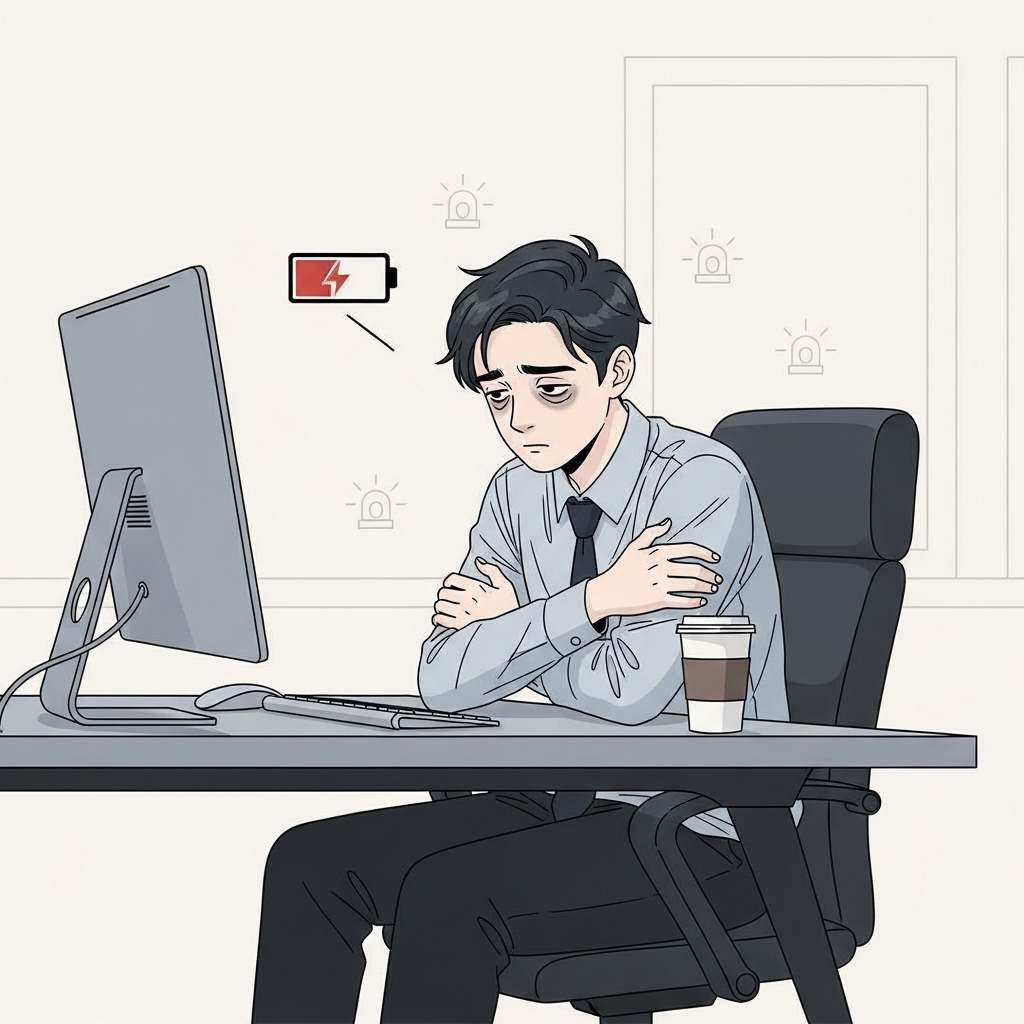
It’s 2:30 PM. The cursor on your screen is blinking. You’re blinking. But nothing is happening.
You’ve had three cups of coffee, but the fog in your brain does not go away. You feel guilty for not being productive, so you force yourself to stare harder at the screen, hoping willpower will kick in.
It doesn’t.
You might think this feeling is a sign of weakness or lack of discipline. But based on my experience in behavioral science and the corporate world, I can tell you it’s actually biology. You are trying to drive a high-performance car in first gear on the freeway. Eventually, you’re going to blow the engine.
Imagine effortlessly breezing through your most challenging tasks, staying sharp and energized from your first coffee to your last email. It’s not a fantasy. It happens when you stop fighting your biology and start using the power of your circadian rhythm. Studies show aligning with these natural cycles can boost your daily output by 20-30%, helping you handle everything from tight deadlines to team demands with ease.
In this article, I’m going to share a practical daily protocol. We will use behavioral science to align your schedule with your body’s natural prime times, literally reprogramming your day for sustained output. I will also share tips with you to ensure that these become long lasting habits for you.
Short on time? Watch this short YouTube video of this topic before you dive into the details below.
The Operational Rule: The 90-Minute Ultradian Pulse
This is the “Golden Rule” that applies inside every phase of your day.
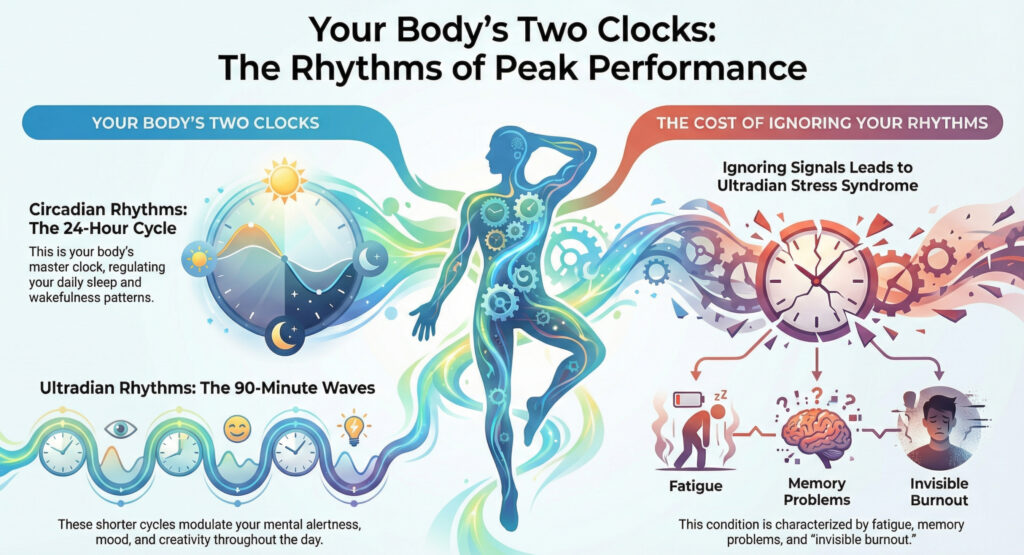
The human brain can only maintain intense focus for 90 to 120 minutes before it needs to “reset.” This is an Ultradian Rhythm. If you push past this peak, you hit a “trough” where mistakes happen and focus fades.
The Ideal Protocol:
Work for 90 minutes, then take a hard 20-minute stop.
How to structure the 20-minute break: The break has two parts. You start with a hard mental reset, then move to physical recovery.
Part 1: The Mental Expansion (Minutes 0–3) Use this 3-minute exercise to immediately shift from “narrow focus” to “Open focus release.”
- Close your eyes.
- Imagine the space: Can you imagine the space between your ears? The space between your shoulders?
- Expand: Let your attention expand to include the silence and space in the entire room. Why it works: Focusing on “space” dissolves beta-wave stress and recharges your mental battery faster than a nap.
Part 2: Physical Disengagement (Minutes 4–20) Once your brain is reset, use the remaining time to recharge the body.
- Hydrate: Drink a glass of water.
- Move: Walk away from your desk. Stretch or look out a window.
- No Screens: Do not check email or social media. This defeats the purpose of the recovery.
Reality Check: “I can’t take 20 minutes.” In many corporate cultures, you can not be away for 20 mins. If you cannot take the full time, do not skip it. Here is how to compress it.
- The 5-Minute Micro-Reset:
- Minutes 1–3: Do the Mental Expansion exercise (at your desk, eyes closed or focused on a distant wall).
- Minutes 4–5: Stand up. Walk to the printer, get water, or stretch.
- The biological win: You are breaking the neurological “tunnel vision.” Even 5 minutes of total disconnection prevents the cortisol buildup that leads to burnout.
Now that you have an understanding of body’s natural rhythms – below is the protocol to optimize it – tailored for busy professionals, whether you’re in back-to-back meetings, leading projects, or juggling remote work. I have also included tweaks for different schedules, like shift workers or those who thrive later in the day.
Phase 1: Morning Momentum (8:00 AM – 11:30 AM)
How do I start my day without anxiety?
The Biology: Your energy hormones peak in the morning. You are biologically primed for “friction” and hard, complex thinking. This is your time to be a high-performer.
The Work: Do not waste this energy on email or Slack. This is the window of time for you to do Deep Work such as:
- Strategic planning.
- Creative writing or coding.
- Complex problem solving.
- Doing the hardest task first.
The Behavioral Tool: The Mindset Shift to the “I Get To”: If you wake up dreading your inbox, you kill your biological energy instantly. The technique is to stop saying “I have to work.” Replace it with a present-tense affirmation: “I get to tackle my most exciting project now.”
Why: It flips the neural switch from “burden” (stress) to “opportunity” (drive)
Habit Formation: The Scorecard: Use a “Habits Scorecard.” Before opening email, physically check a box that says: “I have stated my affirmation.” Ticking the box gives you a micro dose of dopamine to start work.
Pro Tip: Before you start, check off any routines that might drain your energy (like scrolling news in bed) and replace them with your “I get to” statement. For night owls or shift workers, shift this phase to your personal “morning” whenever it falls—maybe 10 AM if you’re on a later schedule.
Reality Check: “My boss books meetings at 9 AM.” If you cannot block 3 hours, fight for The Sacred 60. Block just one hour (e.g., 8:00–9:00 AM) on your calendar as “Strategy Time.” Most leaders respect a single focused hour if they know it produces results. Protect this hour with your life as it is worth 4 hours of distracted afternoon work.
Phase 2: The Midday Pit Stop (11:30 AM – 1:30 PM)
The Biology: Your brain has burned through its morning energy. Your body is shifting into a “digest and recover” mode. If you try to power through this window, you borrow energy from the afternoon, leading to the 2 PM crash.
The Work Transition & Refueling. This block of time should be split between wrapping up morning tasks and taking your break.
- 11:30 AM – 12:30 PM (Buffer Work): Use this hour to clear the “mental RAM.” Reply to urgent messages, return calls, or finish the morning’s tasks. Do not start new deep projects here; focus on closing loops so you don’t carry stress into your break.
- 12:30 PM – 1:30 PM (The Fuel): Eat and disconnect. This is not time for “working lunch.”
- Eat a meal rich in protein and healthy fats (avoid heavy carbs that induce sleepiness).
- Get sunlight (adjusts your circadian clock).
The Behavioral Tool: The Sensory Detox: Your brain processes gigabytes of data all morning. It needs a lack of input to file those memories.
- The Rule: No screens while eating. No podcasts. No news.
- The Action: Look at the horizon or distance. This literally relaxes the ciliary muscles in your eyes and signals safety to your nervous system.
Habit Formation: The “Building Exit”: Build a trigger: When you smell lunch, you must step outside a door. Even if it is just for 5 minutes, physically changing your environment breaks the “work trance” and resets your focus.
Reality Check: “I have to do a working lunch.” If you cannot leave your desk, you must still achieve the Sensory Detox.
- The Rule: Monitors Off while chewing.
- The Action: Even if you only have 10 minutes to eat at your desk, turn your chair away from the screen or dim the brightness to zero. Your brain cannot digest food and complex data simultaneously without crashing later. Give your eyes (and brain) 10 minutes of single-tasking (eating) before turning the screen back on.
Phase 3: The Afternoon Bridge (1:30 PM – 5:00 PM)
The Biology: Most people experience a postprandial dip where sensory and perceptual functions slow down as the mind and body turns inward for “housekeeping”. Sleep pressure begins to build up. Focus naturally wavers, making deep solitary work difficult.
The Signal: You start sighing, fidgeting, or staring blankly. This is your body asking for a quick recharge, like during a long team meeting when ideas stall.
The Work Stop fighting the dip with high-intensity focus. Use this time for Interaction & Admin.
- Meetings and calls (social pressure keeps you awake).
- Clearing the inbox.
- Administrative tasks that require less cognitive load.
The Behavioral Tool: Temptation Bundling: You will likely feel resistance to starting work again and have to use behavioral science to trick the brain. Don’t grab caffeine; it will just mask the fatigue. You need to shift from tense, narrow focus to a relaxed, open state. Try this for 3 minutes:
- The Trigger: Before you stand up, perform the Mental Expansion (3 mins) to detach from the screen.
- The Bundle: Combine something you need to do (movement/waking up) with something you want to do (entertainment).
- The Action: Take a 20-minute walk where you listen to your favorite podcast or audiobook.
- The Rule: You are only allowed to listen to that podcast while you are walking.
For remote workers, do this around your home office; for shift schedules, apply it during your mid-shift low point.
Habit Formation: Make it Easy. Redesign your environment to have a “relaxation kit” (headphones/cushion) ready so taking the break requires the least effort. Also only listen to your favorite professional podcast (Want) while you are doing your afternoon movement/stretch (Need).
The Energy Log: For one week, log your energy level (1-10) at 2:00 PM. Note which “bundle” (Music? Podcast? Fiction audiobook?) resulted in the highest energy return. This data helps you solidify the routine.
Reality Check: “I can’t leave the building.” If you cannot go for a walk, bring the movement to you.
- Step 1: The Micro-Reset: Perform the 3-minute Mental Expansion at your desk.
- Step 2: The Stairwell Sprint: If you work in a high-rise, spend 5 minutes walking up and down two flights of stairs. The goal is blood flow and oxygenation.
- Alternative: The Standing Meeting: Take your afternoon calls standing up or pacing in your office
Phase 4: The Power Down (5:00 PM – Bedtime)
How do I stop thinking about work at night?
The Biology: Your cortisol drops, and melatonin production begins as light fades. Your brain attempts to switch from “sympathetic” (fight/flight) to “parasympathetic” (rest/digest). Carrying work stress into this phase ruins your recovery for tomorrow.
If you carry work stress home or keep thinking about work before going to bed, you ruin your recovery for tomorrow. You need to close the loop.
The Work: Closing the Loop: This phase is not for new projects; it is for reflection and preparation to ensure you sleep with a clear mind.
The Behavioral Tool: The Daily Brag & Future Pace We need to close the “open loops” in your brain so you can sleep.
- The Daily Brag: Write down 3 things you did accomplish. This forces your brain to associate work with achievement, not failure.
- Future Pacing: Visualize your day tomorrow going perfectly.
- The Anchor: As you visualize this success, squeeze the knuckle of your ring finger. This creates a physical trigger for calm confidence you can use anytime.
Habit Formation: The Shutdown Ritual: Create a physical “shutdown” action. Close your laptop, tidy your desk, and say out loud, “System Shutdown.” This physical and verbal cue signals to your brain that the “Work” phase is over and the “Life” phase has begun.
Use a habit tracker (crossing off days on a calendar) to provide immediate visual proof that you are becoming the type of person who masters their time.
Prefer to listen on the go? Tune into the Audio Deep Dive version of this article, where we discuss the behavioral nuances and hidden scripts that didn’t fit in the text.
The Bottom Line: Be The High-Performer
You don’t need more time. You just need to repattern your day like tuning a high performance vehicle. By heeding your internal “dials” (ultradian signals), you allow the machine to heal itself and function at peak efficiency.
By respecting your circadian and ultradian rhythms, you aren’t being lazy. You are engaging in personal transformation. You are treating your body like the high-performance machine it is —whether you’re an early riser, night owl, or on irregular shifts.
Ready to master your personal performance? This protocol is just the first step in the Change For Results R.E.A.L Change framework.
- Dig Deeper: Read my detailed guide on Burnout in my latest eBook – “The Burnout Fix” at https://www.amazon.com/dp/B0FZWSJ63P
- Get Support: If you are a leader looking to implement these strategies for your employees, let’s talk. Visit www.changeforresults.com or connect with me on LinkedIn.
About the Author: Kaushik Nag spent more than 35 years as a Fortune 500 HR executive and a Behavioral Coach, coaching thousands of professionals and leaders through workplace challenges. His current work distills that experience into practical, behavior science based strategies you can use immediately. Learn more at www.changeforresults.com. For insightful articles on both individual and organizational change click here or visit his YouTube channel for short easily digestible behavioral tips you can use at the workplace.