AI Workplace Stress in 2026: 5 Behavioral Strategies to Harness Tech for Calm and Peak Productivity

It is 2026. You log in to work, and the pace has changed. We aren’t just dealing with “new software” anymore. We are dealing with a fundamental shift in how we exist at work caused by AI adoption. I have been a HR executive and behavioral coach for over 35 years but these days the number of complaints I hear about people being “Exhausted” has crossed all expectations. The stress isn’t coming from the AI itself—it’s coming from what the AI represents.
- The Fear of Lay0ff: You worry that if you aren’t the fastest, you’ll be replaced by AI or a younger, tech-savvier employee.
- The “Double Workload”: You are expected to deliver your normal performance while simultaneously learning complex new AI tools. It feels like working two jobs at once.
- The “Always-On” Pressure: In Human-AI hybrid teams, the bot never sleeps, so you feel like you can’t either.
This is AI-Induced Workplace Stress and it is leading to burnout, decision fatigue, and a constant state of “fight-or-flight.” Standard advice to step away from digital devices like smartphones, computers, and social media or to do meditation does not help. You need practical tools. Drawing from NLP, CBT, Hypnotherapy, and Behavioral Psychology, I’ve outlined 5 proven strategies to help you stop reacting to this stress and start handling it.
Five Strategies for Managing Stress and Anxiety using Behavioral Science
Short on time? Watch this short YouTube video on the Topic before you dive into the details below.”
Strategy 1: Reframe AI Stress Triggers
The Problem: You see a new AI update and immediately think, “I can’t learn this fast enough. I’m going to be displaced.” This is a “Negative Automatic Thought” (NAT) that triggers anxiety before you even start working.
The Solution: You need to catch these thoughts and “reframe” them. You must replace the fear of replacement with the power of learning.
The Evidence: Research shows that changing the language you use to describe a problem changes your brain’s chemical reaction to it.
How to do it:
- Identify the Root Fear (The Downward Arrow):
- When you feel anxious, ask yourself: “If this thought is true, what does it mean about me?”
- Thought: “I can’t use this AI tool.” -> Meaning: “I’m slow.” -> Core Fear: “I will lose my job because I’m obsolete.”
- The Reality Check (Displacement vs. Adaptation):
- Challenge that fear with a fact. Remind yourself: “AI replaces tasks, not people.”
- Tell yourself: “My job security doesn’t come from being faster than a robot. It comes from learning the new skills to guide the robot. As long as I am learning, I am safe.”
- Use the “Yet” Rule:
- Never say “I can’t do this.”
- Say: “I can’t do this yet.” This simple word tells your brain that you are in the process of learning, not failing.
Strategy 2: Build Instant Calm with Anchors
The Problem: An urgent notification or an AI error pops up, and your heart races. You are in “panic mode” instantly.
The Solution: Use “Anchoring.” This is a technique to trigger a specific emotional state (like calm or confidence) by touching a specific part of your body.
The Evidence: Pavlovian conditioning proves we can link a physical touch to an emotional response.
How to do it:
- Elicit the Feeling: Close your eyes and remember a specific time you felt totally safe and confident. See what you saw, hear what you heard, and feel that feeling grow strong.
- Set the Anchor: Right when that feeling is at its peak intensity, firmly squeeze the knuckle of your ring finger for 5 to 15 seconds.
- Break State: Open your eyes and count backward from 10 to reset your brain.
- Test It: Squeeze that knuckle again. You should feel a wave of that original calm return.
- Daily Use: The next time AI stress hits, squeeze your knuckle while taking a deep breath (inhale for 4 seconds, hold for 4, exhale for 4).
Strategy 3: Interrupt the “Overwhelm Loop”
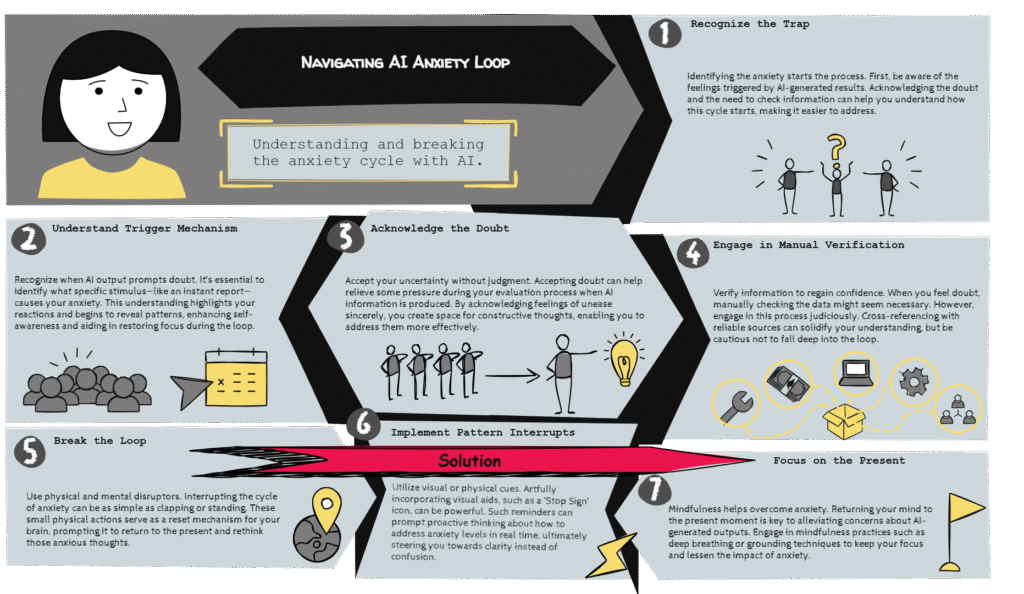
The Problem: One would think AI would make us more productive. But these early days of AI it is often not the case. People are suffering from what is called “AI Fatigue”. This often stems from one of our psychological habit called “Looping.”
Imagine this scenario: You ask an AI agent to generate a report. It finishes in seconds. But instead of moving on, you stare at the screen. You check the data. Then you check it again. Then you refresh the page to see if anything changed. You check a third time “just to be sure.” Your brain is looking for certainty, but because AI can “hallucinate,” you never quite feel 100% sure. So, you get stuck in a cycle: Check -> Worry -> Check Again. This burns up your mental energy.
The Solution: A “Pattern Interrupt.” You cannot think your way out of a loop; you have to physically break the cycle to reset your brain.
How to do it Step-by-Step:
- Spot the Loop: Catch yourself in the act. Are you unnecessarily worrying about the accuracy of a finished task? Are you constantly checking the result even though it seems correct?
- The Physical Snap: Do something unexpected to shock your system. Stand up abruptly, clap your hands once loudly, or say “STOP” out loud.
- The “Fingers Rubbing” Technique:
- Rub your thumb and index finger together.
- Focus only on the texture. Is it smooth? Dry? Warm?
- Describe the sensation to yourself (e.g., “I feel the ridges of my fingerprint”). This forces your attention away from the “future worry” (the loop) and anchors it in the “physical reality” (your hands).
Strategy 4: Trick Your AI Skills Learning Motivation using Psychology
The Problem: You are procrastinating on learning a new AI skill because it feels too big and scary.
The Solution: Master your internal motivation direction using the “Pain vs. Gain” principle.
The Evidence: Humans are motivated by two things: moving toward a reward or moving away from pain.
Process to do it :
- Know Your Motivation Trigger: Are you more motivated by winning (getting a promotion) or by not losing (not getting fired)?
- The Sandwich Suggestion Model: Frame the task to yourself in this specific order:
- Suggestion: “I am going to spend just 20 minutes learning this AI prompt…”
- Avoid Problem (Away): “…so I don’t have to stress about it all weekend…”
- Benefit (Toward): “…and I can enjoy a guilt-free evening with my family.”
- Clean Language: When you feel stuck, ask yourself: “What needs to happen for me to feel okay right now?” This shifts your brain from dwelling on the problem to finding a solution.
Strategy 5: Personalize Your Resilience (The R.E.A.L. Framework)
The Problem: You feel like you are losing your identity to AI as Bosses increasingly talk about using AI to do what you did earlier. You worry that your unique human experience doesn’t matter anymore.
The Solution: Use my R.E.A.L. Change Framework™ to prove to yourself that you are adaptable.
Step-by-Step Implementation:
- Reveal (The Worry Map): Write down exactly what triggers you. Is it the email from your boss praising AI ? The dashboard screen? The water cooler talk about AI related Layoffs? Map out your physical reaction (sweaty palms, tight chest).
- Eliminate (Cognitive Defusion): Imagine your negative thoughts about AI are just clouds floating across the sky. You are the sky; the thoughts are just weather. They will pass.
- Acquire (The Change Resume):
- List every big change you have survived in your career (e.g., shifting to remote work, learning Excel, new management).
- Read this list to prove to your subconscious: “I have adapted before, I can do it again.” Remind yourself: ” I am already learning new skills”
- Lock-In (Future Pacing): Close your eyes and imagine a future scenario where you are using AI easily. Rehearse success in your mind.
Conclusion: You Are More Than Your Productivity
The rise of AI in 2026 is inevitable, but burnout is not. The key to surviving AI job transformation isn’t just learning to code. It’s learning to manage your own mind. By using these behavioral tools, you can silence the fear of displacement and handle the pressure of hybrid work without losing your sanity. Remember: AI is a powerful tool, but it lacks human intuition, empathy, and resilience. That is your edge. Ready to take the next step? If you want to master these techniques and build true career confidence, here is how I can help:
About the Author: Kaushik Nag spent more than 35 years as a Fortune 500 HR executive and a Behavioral Coach, coaching thousands of professionals and leaders through workplace challenges. His current work distills that experience into practical, brain-based strategies you can use immediately. Learn more at www.changeforresults.com
Connect with Kaushik on LinkedIn here.
For insightful articles on both individual and organizational change click here or visit his YouTube channel for short easily digestible behavioral tips you can use at the workplace.
Reach out below to request the complimentary “Boundary Script Cheat Sheet“