Overcoming Resistance PROSCI Missed: 3 Behavioral Nudges for 2026 Corporate Transformations
In my 35 years running global change COEs, I have watched brilliant change management strategies fail in the execution phase. In fact, a staggering 70% of change initiatives do not produce the desired results because leaders mistake human psychology for an administrative checklist. Here’s how to fix the behavioral resistance traditional frameworks including PROSCI miss.
In my experience, majority of the Organizations hit a brick wall during rollout. They spend millions on implementing new technology, processes, organizational structures or operating models. But things do not go the way they plan and even if they implement the change, they can’t sustain it..
It’s rarely a planning problem. It fails because people do not like to disrupt the status quo, and change leaders ignore that fact. Employees don’t resist change to sabotage the company. They resist because the human brain is wired to prefer the familiar.
Behavioral scientists call this “Status Quo Sloth.” It’s the natural tendency people have to maintain existing habits. Add loss aversion on top, and you get into a crisis. Nobel laureate Daniel Kahneman proved we’re twice as motivated to avoid a loss as we are to chase a gain. Giving up an old process hurts twice as much as learning a new one feels good.
Frameworks like PROSCI’s ADKAR model (Awareness, Desire, Knowledge, Ability, Reinforcement) are essential. But they’re not enough for the speed of 2026. You have to bridge the gap between logical business needs and irrational human psychology.
That’s where I recommend the use of behavioral nudges. They’re subtle interventions that change behavior without forcing anyone’s hand.
Here are three evidence based techniques I have used in the past to cut through cognitive friction and drive real adoption.
Why do employees hide their real concerns during a rollout?
The case
I was in a meeting with the executive team of a mid-sized financial services firm. The VP of Operations had just laid out a pitch for transitioning to a new agile workflow system. The data was solid. The slide deck was tight.
The middle managers around the table nodded politely.
But I have had informal discussions before the meeting. I knew those same managers were terrified — worried about compliance bottlenecks, back-to-back meetings, team chaos. When the VP asked for questions, nobody spoke. Nobody wanted to look like they weren’t a team player.
The problem is that the suppressed fear doesn’t go away. It translates into quiet resentment. Polite nodding is the most deceiving indicator in corporate change. It kills the “Desire” phase of ADKAR before the implementation even starts. Sure enough, when the rollout began, passive resistance hit like a wall. The initiative started bleeding money.
The science and the fix
Leaders suffer from optimism bias. They build rosy, best-case plans and expect everyone else to see what they see. But in reality, it does not happen. People have no idea of what the future will look like.
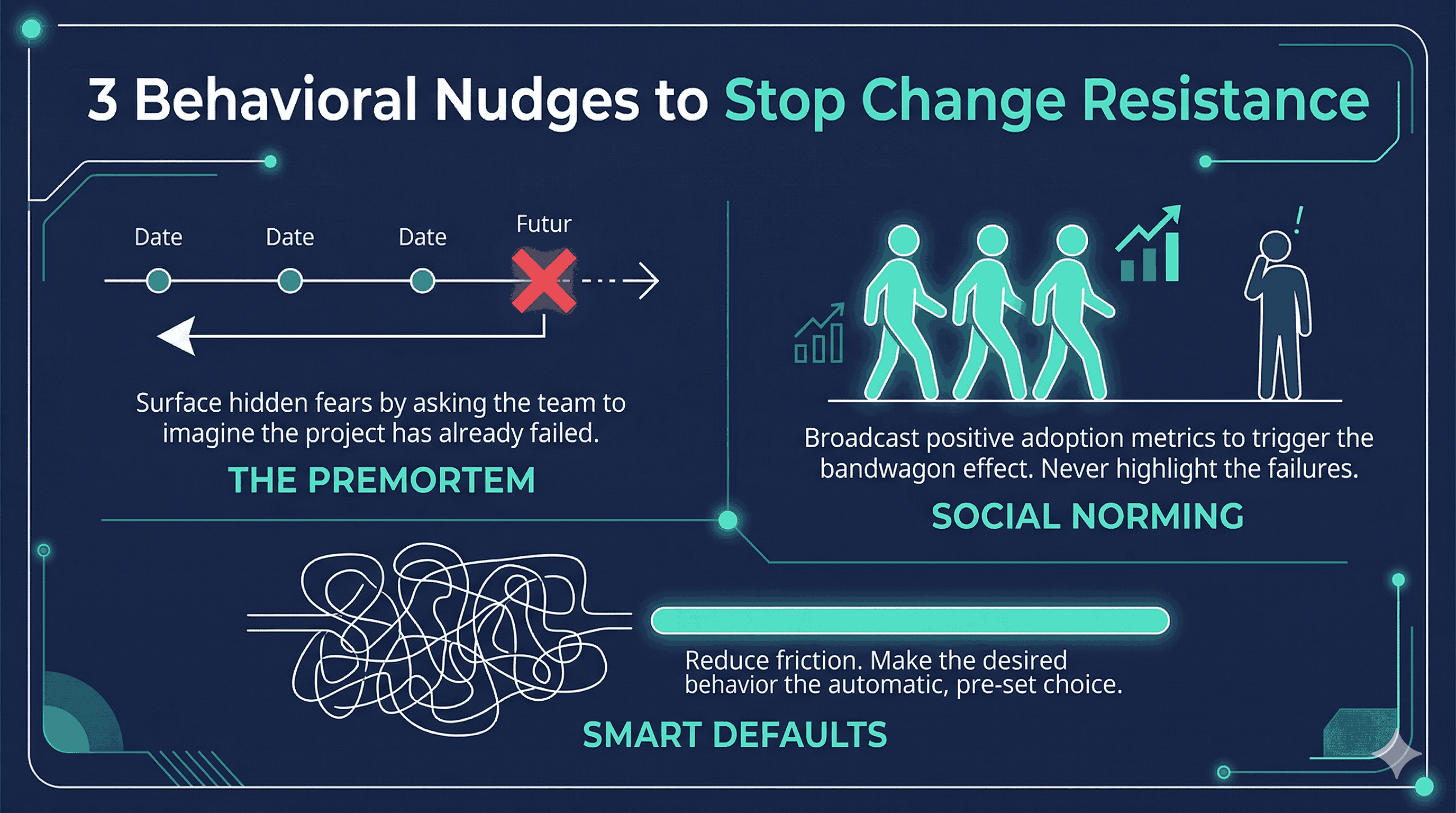
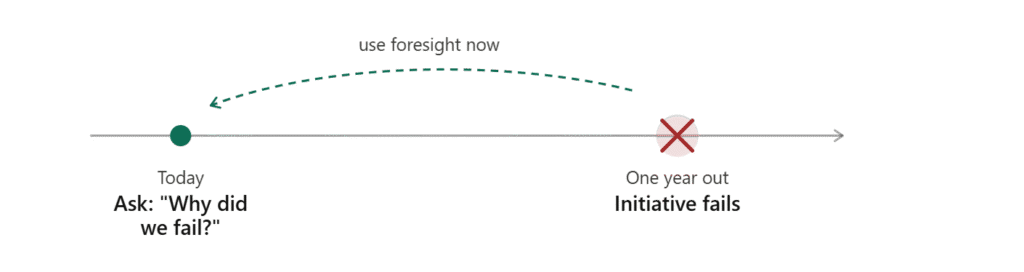
The solution is a Premortem — a technique developed by cognitive psychologist Gary Klein. Instead of asking “does anyone have concerns?”, you go with the assumption that the project already failed. Then you ask the team why.
This breaks the groupthink that forms once a decision looks final. It makes it safe — even socially rewarded — to point out flaws. PROSCI tells you to build Desire. The Premortem clears the fear that’s blocking it.
How to run one:
Gather the team right before formal commitment. Announce that the project has failed spectacularly. Give them five minutes to write down exactly why.
Don’t say: “Does anyone have concerns or feedback about this initiative?”
Say this instead: “Imagine it’s one year from now. This initiative was a complete disaster. Take five minutes and write down exactly why we failed.”
What’s one unspoken resistance trigger currently hiding in your team?
How do you fix low adoption without threats?
The case
A regional executive called my COE in a panic. Their sales force was migrating to a complex new CRM. Adoption was stuck at 60%.
The Sales Director was furious. He showed me a draft email he was about to blast to the entire division. It was aggressive — pointing out that 40% of the team was failing to log in and threatening consequences.
I told him to delete it.
He was about to make a classic behavioral mistake. By loudly announcing how many people weren’t using the software, he was about to accidentally tell the organization that not adopting it was perfectly normal.
The science and the fix
When people are uncertain, they look to the group. Robert Cialdini calls broadcasting negative behavior “the big mistake.” It provides negative social proof — and it signals that non-compliance is the norm.
The fix is Social Norming (The Bandwagon Nudge): make people aware of what the majority is already doing. People want to fit in. Nobody wants to be the laggard. ADKAR’s Reinforcement phase runs on this.
We rewrote the email. The remaining 32% suddenly realized they were in the minority — and didn’t want to look like they were falling behind. Platform adoption spiked. No threats. No drama.
Here’s the playbook:
Find the positive metric, even if it’s barely a majority. Broadcast it loudly. Frame the non-adopters as a shrinking group that needs support, not a failing group that needs punishment.
Don’t say: “A large number of you still haven’t transitioned. Please do so immediately.”
Say this instead: “We’re thrilled that over 70% of the team has already made the switch. For the remaining few — reach out if you need help catching up.”

What’s one negative norm your leadership team might be accidentally broadcasting right now?
How do you make a new process actually stick?
The case
The global logistics division in one of the companies i worked for, was fighting a losing battle with data security. They wanted employees to stop saving sensitive files on local drives and start using a secure cloud system.
They ran extensive training. Everyone knew the why and the how. The Knowledge phase of ADKAR? Nailed it.
Six months later, behavior hadn’t changed.
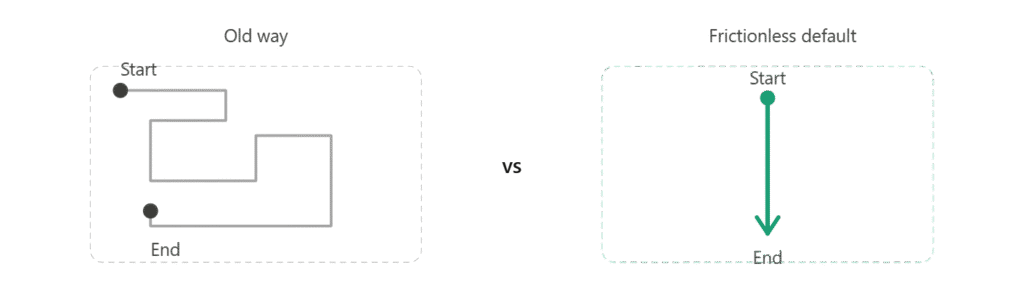
I sat with an employee and watched their workflow. Getting to the cloud folder took three extra clicks. Saving to the local drive took one.
The company was relying on willpower. Willpower always loses to friction.
The science and the fix
The Law of Least Effort is simple: when choosing between two options, people take the path that requires the least work. Every extra click is a reason to revert.
The most powerful tool you have is Friction Reduction via Defaults: Because of status quo bias, people stick with whatever is pre-set — it requires zero decision-making.
I advised the IT team to stop mandating training. Instead, they quietly changed the default “Save As” destination on every laptop to the secure cloud. Employees could still click back to their local drive. Almost no one did. Adoption happened overnight.
How to apply it:
Audit every step the new behavior requires. Remove every unnecessary click, form, or decision. Make the right choice the automatic one.
Don’t say: “Please remember to update your settings to the new platform by Friday.”
Say this instead: “Your settings have automatically been updated to save you time. If you strongly prefer the old method, here’s a link to revert.”
Where is the hidden friction slowing down your current rollout?
Designing a frictionless future
Organizational change is always hard. But it doesn’t have to be a war against human nature.
Leaders who win in 2026 won’t be issuing mandates. They’ll be acting as choice architects — using premortems to surface real fear, descriptive norms to harness social proof, and smart defaults to remove friction entirely.
Stop fighting your employees’ psychology. Start leveraging it. Believe me, this is the key to success in organizational transformation.
About the Author
Kaushik Nag is a Behavioral Coach, Author and former global HR Executive with more than 35 years of experience across multiple industries. He has built and led global Organizational Change Management Centers of Excellence, consulting on major transformations across 100 international markets. Today he helps operations executives and organizational leaders improve productivity through behavioral interventions and fix the human side of change when traditional frameworks stall.
Learn more about his coaching services at www.changeforresults.com
For articles on Individual and organizational change, follow Kaushik’s blog. For short videos on Behavioral change subscribe to his YouTube Channel.