Why Your 2026 Change Initiatives Fail (And 3 Behavioral techniques Leaders Can Use to Sustain Organizational Change via Employee Habits)
You ran the training, conducted workshops. You sent the emails. You checked every box in the rollout plan.
Thirty days later, the team has quietly gone back to doing things the old way.
This is the most common — and most expensive failure in corporates to sustain organizational change. And in my 35 years leading global OCM Centers of Excellence for Fortune 500 companies, I can tell you it almost never comes down to stubborn employees or bad attitudes.
It comes down to the employee neurology.
Your employees aren’t sabotaging your 2026 AI integration or your new hybrid workflow project. They’re exhausted of all the changes they are having to go through. And you’re asking their brains to do something brains actively resist: abandon a deeply ingrained routine and replace it with a new one — on willpower alone.
PROSCI’s ADKAR framework is great. In my career i have extensively used this and other similar frameworks. It gets people to the starting line. But when you hit the Ability and Reinforcement phases, awareness and desire are no longer enough. Knowing why a change matters does not automatically rewrite a daily habit. To sustain transformation, you have to build behavioral momentum. Mandating it will not work.
Below i am sharing with you three behavioral methods I have coached corporate leaders to apply for change sustainment..
Why do employees revert to old habits after Go-Live?
The problem: Trusting Employees to Remember the new process
Some time ago, I consulted for a global financial technology firm rolling out a critical AI-driven cybersecurity protocol. It required a manual threat-check routine every morning. The communication campaign was flawless. Week-one compliance hit 100%.
By week four however, it had collapsed to 32%.
The HR director wanted to issue formal warnings. I stopped her. I sat with a dozen engineers instead. They didn’t hate the new protocol. They were just overwhelmed. They already managed six login portals, three communication platforms, and back-to-back meetings. They simply forgot.
Leadership had made an assumption that because they had trained and constantly reminded employees to follow the new process — the employees would do it. They did not realize that relying on employee memory to drive a new behavior in a distracted hybrid environment is a guaranteed recipe for failure. ADKAR gets people to the starting line. It doesn’t pave the road after it.
The science: habit stacking
Behavioral scientist BJ Fogg has shown that no behavior happens in isolation. You as a leader will have to create new behaviors for your employees, if you want them to move forward with the change. These new habits will then need an anchor — a reliable trigger in the existing environment. If you plant a new behavior in the middle of nowhere, with no connection to what people already do automatically, they will drift back to the old behavior.
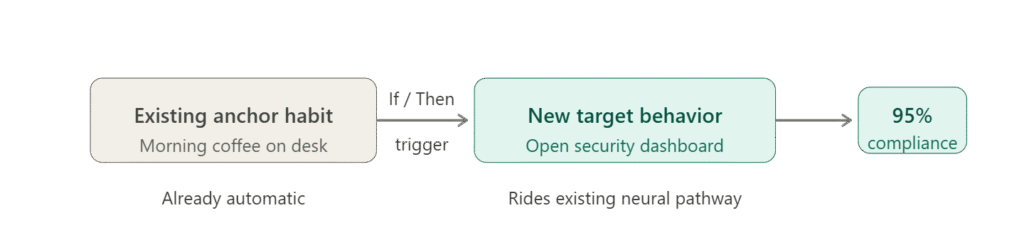
The technique is called Habit Stacking: you attach the new behavior directly on top of an already entrenched daily routine. This way you will not be creating a new neural pathway from scratch. You will be hijacking one that already runs on autopilot.
The fix: piggyback on the inevitable
I asked the team to stop sending reminder emails. They were asked to stop mandating additional training. Instead, the project team asked each employee to identify their single most reliable morning habit and link the security check to it. For most, that was their morning coffee.
Three steps: find the anchor, attach the new behavior with a strict If/Then rule, make the trigger physical and immediate.
Compliance climbed to 95% and held there permanently.
Don’t say: “Please remember to log in to the security dashboard every morning.”
Say this instead: “To make this effortless — after you set your morning coffee on your desk, make opening the dashboard your very next click.”
What’s one shared daily habit your team already does on autopilot that could anchor your next rollout?
How do you overcome Change adoption resistance in organizations?
The problem: the Pain of using a new system
I watched a high-performing sales organization nearly tear itself apart over a CRM migration. The old system was clunky but familiar. The new one was a powerhouse — predictive analytics, better pipeline visibility, cleaner reporting. The sales Leaders wanted it implemented immediately.
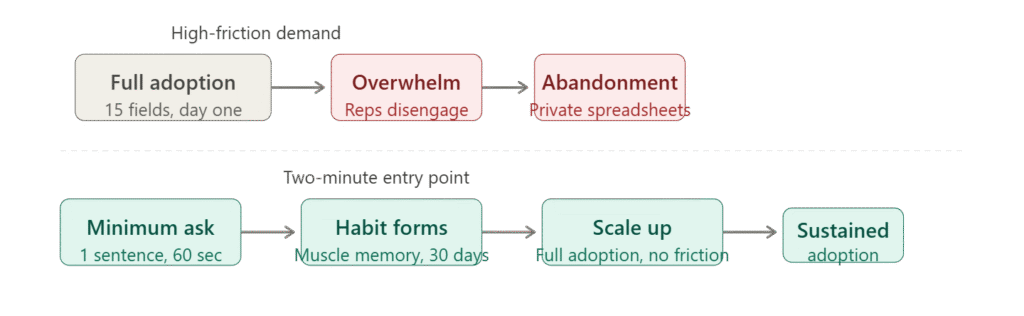
One thing no one paid attention to – the new CRM system required 15 distinct data fields per client profile.
Reps felt overwhelmed. They abandoned the platform and started hiding data in private spreadsheets. The VP of Sales then wanted to tie CRM usage to commission structures. I warned him: leading with a stick doesn’t fix resistance. It just drives it underground.
The science: the law of least effort
Human behavior follows the path of least resistance — always. Standard change management often demands a “big bang” adoption: go from zero to full compliance immediately. In 2026, when your teams are already overloaded with tools, platforms, and competing priorities, expecting employees to do that is asking for too much without any motivation.
The research is clear. You have to standardize the habit of showing up before you can optimize actual performance. Compliance built on anxiety collapses. Compliance built on muscle memory holds.
The fix: the two-minute rule
I advised the project team to strip the requirement to its bare minimum. Managers were temporarily banned from asking for full client profiles. The only expectation: open the CRM, log one sentence about one client call. That’s it. Sixty seconds.
Three steps: shrink the task until it takes under two minutes, reward the attempt not the output, then gradually raise the bar only after the daily habit is neurologically established — typically after 30 days.
Within three weeks, the anxiety vanished. The muscle memory was built. We then expanded requirements with almost no resistance.
Don’t say: “You must enter all your daily sales data into the new CRM before you leave today.”
Say this instead: “For the next two weeks, your only goal is two minutes — log one client update. We’re just building the muscle of using the new system.”
Look at your current change initiative. What’s the single smallest action that still counts as adoption?
What’s the best way to sustain long-term behavioral change in the workplace?
The problem: the delayed return
An operations department was failing an audit on a new data privacy policy. The changes were tedious. The payoff was invisible.
Management kept emphasizing the policy’s importance for the annual risk assessment. The team didn’t connect with it. An annual risk assessment is an abstraction — it means nothing on a stressful Tuesday afternoon when you’re three tasks behind. Compliance slowly eroded back to the old habits.
The science: immediate reinforcement
Here’s the rule that most corporate change programs violate: behaviors are repeated when they are immediately satisfying and avoided when they are immediately uncomfortable. That’s it.
Most organizational changes suffer from a delayed return problem. The company sees the financial payoff in six months. The employee feels the daily annoyance right now. PROSCI rightly emphasizes long-term reinforcement — but behavioral science says you also need a daily signal that the new behavior is winning. Without that signal, willpower runs out.
The fix: visual habit tracking
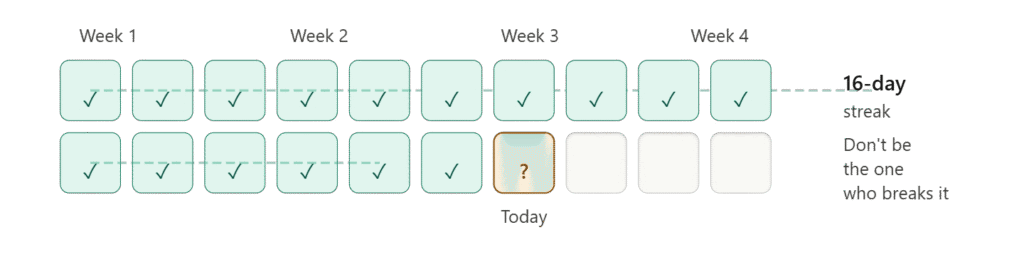
We introduced a low-tech solution into a high-tech environment: a large whiteboard graph in the break room. Every day the team hit 100% compliance, they added a green checkmark to the chain.
Three things made it work: progress was visible to everyone, not buried in a dashboard; streak psychology kicked in — nobody wanted to be the one who broke a 14-day chain; and the social accountability was immediate, not quarterly.
The daily satisfaction of marking the board became the reinforcement the policy could never provide on its own. New privacy protocols became second nature.
Don’t say: “Keep up the good work. We’ll review compliance numbers at end of quarter.”
Say this instead: “Every day we hit the new standard, we add a green check to the board. Let’s see how long we can keep the streak alive.”
How are you currently giving your team a daily, visible signal that the new behavior is working?
The real reason sustained change is so hard
These three problems —Trusting Employees to Remember the new process, the Pain of using a new system, and the Delayed Return — are why most change initiatives hit a wall at the 30-day mark. They’re not people problems. They’re design problems.
The leaders who drive lasting transformation in 2026 won’t rely on willpower and warning emails. They’ll design environments where the new behavior is the easiest, most visible, most immediately rewarding path.
ADKAR gets you the awareness and the desire. Behavioral science gets you the follow-through.
Hopefully the above techniques will help you overcome the employee resistance significantly. For customized solutions to an organizations’ unique challenges, additional behavioral interventions can be designed. Please reach out for a free strategy session.
About the Author
Kaushik Nag is a Behavioral Coach, Author and former global HR Executive with more than 35 years of experience across multiple industries. He has built and led global Organizational Change Management Centers of Excellence, consulting on major transformations across 100 international markets. Today he helps operations executives and organizational leaders improve productivity through behavioral interventions and fix the human side of change when traditional frameworks stall.
Learn more about his coaching services at www.changeforresults.com
For articles on Individual and organizational change, follow Kaushik’s blog. For short videos on Behavioral change subscribe to his YouTube Channel.